
Backpack
Electrofishing
Certification
-
 Course taught by Curtis Vieville
- Level: Advanced

We offer this program as a custom delivery. Please contact us to schedule a course date and location.
Available Dates
Description
Become NAIT-certified in Electrofishing
The ESTI Backpack Electrofishing Course offers practical training on safe operating, handling, and relocating fish from water.
Are you entering the industry with little to no field experience, or looking to build on the skills you already have? Do you need to recertify your electrofishing practice? The ESTI Backpack Electrofishing Course serves to certify participants in the fundamentals of electrical theory, fish handling methods, equipment and backpack electrofishing safety.
The ESTI Backpack Electrofishing Course is developed in accordance with the WorkSafeBC curriculum in partnership with the Northern Alberta Institute of Technology (NAIT). After taking the course, you’ll be able to do the following:
- Understand and identify the safety hazards and mitigations associated with backpack electrofishing.
- Apply electrical theory to field-level electrofishing equipment settings to achieve sampling success while minimizing potential harm to fish.
- Safely operate, troubleshoot, and maintain modern backpack electrofishing units.
- Manipulate the electrical field to optimize fish capture and minimize fish stress.
- Practice safe electrofishing habits, including equipment selection and operation.
- Identify and describe key personal protective equipment related to electrofishing.
- Identify and describe key safety features related to electrofishing equipment.
- Respond effectively to an electrofishing-related incident and apply standard emergency response procedures.
- Demonstrate safe fish handling and processing techniques.
- Understand the importance of equipment decontamination in preventing the spread of aquatic disease and invasive species and effectively decontaminating equipment.
Curriculum Snapshot
This thorough 1.5 day course covers all you’ll need to safely practice backpack electrofishing.
- Day One: A foundational classroom session that covers electrofishing theory, application and safety.
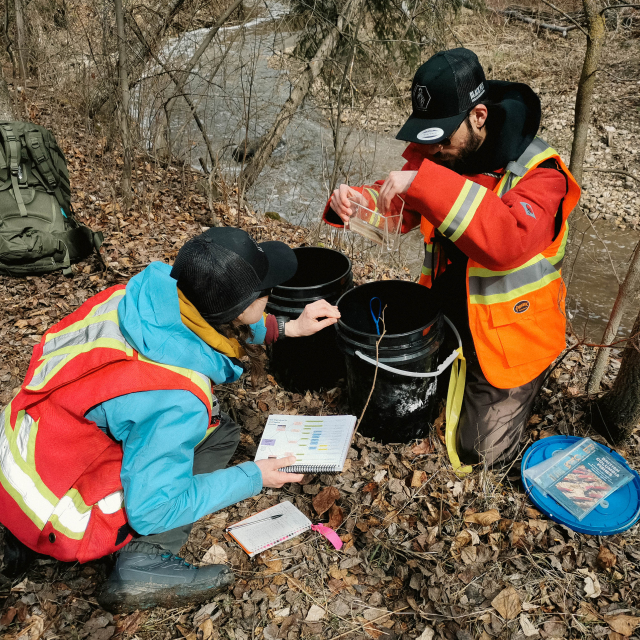
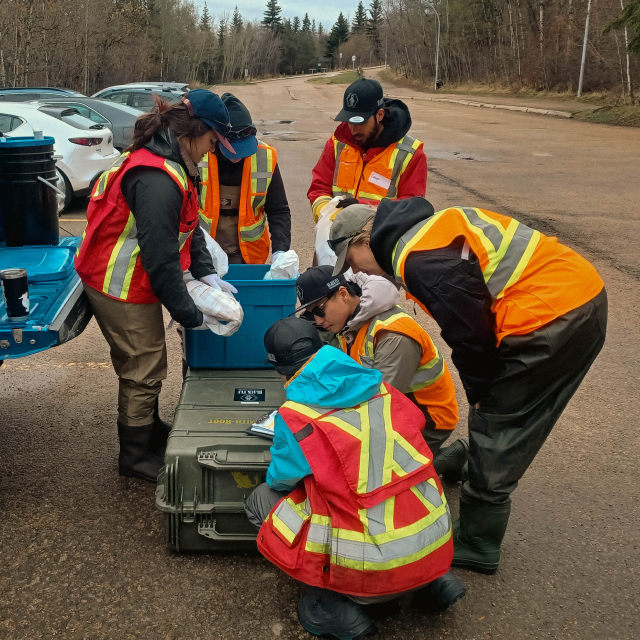
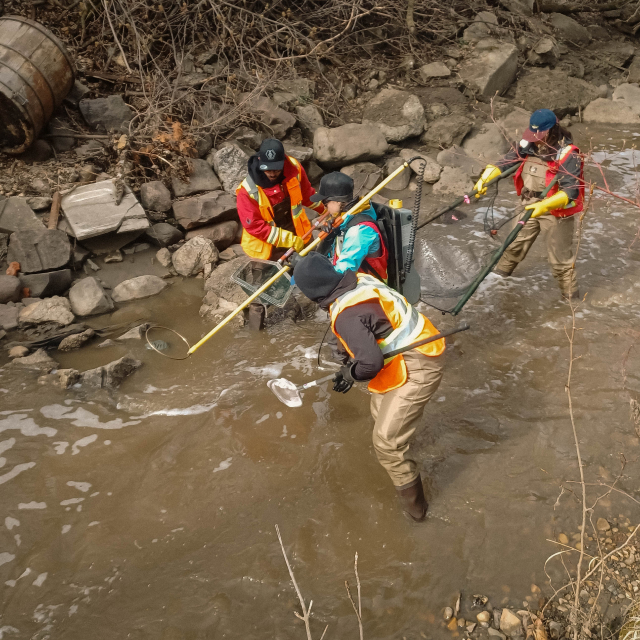
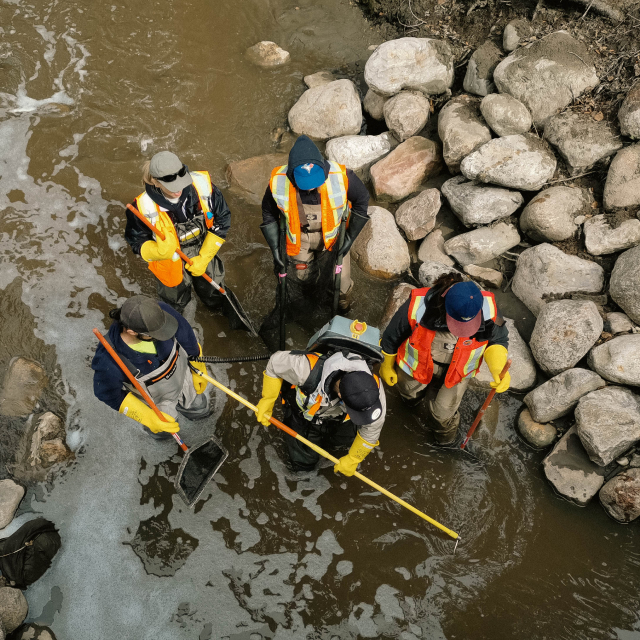
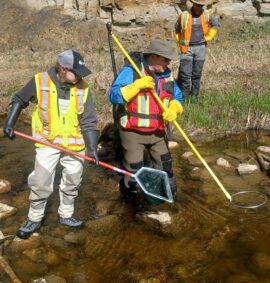
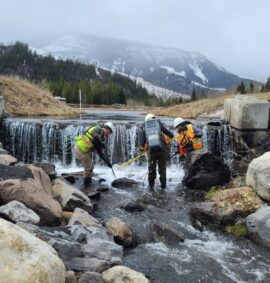
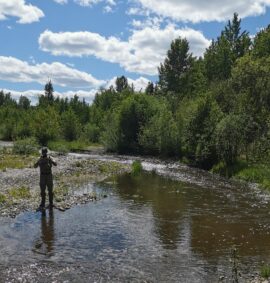
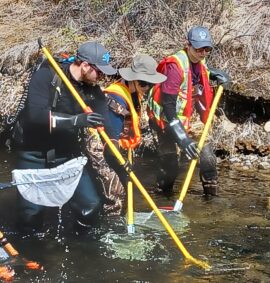
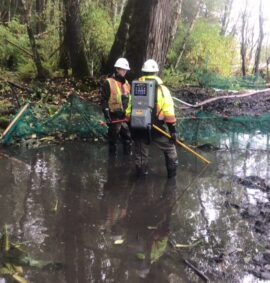
- Day Two: A practical hands-on session where students will practice electrofishing in a field setting using a Smith-Root LR-24 backpack electrofisher. Each participant must demonstrate safe operation of equipment (as efisher and netter) and fish handling.
Students are issued a NAIT Certificate of Achievement upon successful course completion.
Testimonials
Backpack Electrofishing Launch!
Tacy – Curtis was informative and kept us engaged throughout the whole course. His emphasis on safety protocols made me feel confident during the practical sessions. Curtis’s depth of knowledge in the field truly shines, making him a great instructor!
Instructor Profile

Curtis Vieville
Environmental Construction Specialist
Curtis is a talented professional in the restoration and protection of riparian habitats through his experience in construction and water quality monitoring, stream bank restoration, pipeline and bridge construction, community outreach and education, wildlife surveys, and fish salvage and relocation. Durting the past number of years Curtis has embraced the role as a team leader and mentor, particularly in aquatics situated in industrial settings.
Thoughts from the Field
After graduating from the University of Alberta, I started my professional career in 2013. Since then, I’ve been working in bushland for about 10 years in the field of aquatic biology, interspersed with vegetation and restoration work.
Shortly after joining Black Fly Environmental in 2019, I specialized in fisheries and aquatics consulting for construction projects throughout BC and Alberta. Like many other environmental professionals, I was heavily involved with the Coastal Gaslink and Trans Mountain Expansion projects during the past five years, providing environmental monitoring, wildlife sweeps, and salvages.
In the early days, I cut my teeth with many bridge replacement projects (“bridge files”) and fish salvages, often in the freezing cold of northern Alberta.
Much of this work involved a backpack electrofisher to assist in fish salvage and relocation. We do this to capture all the fish that were missed during earlier trapping and seining in the salvage, without harming or stressing the remaining resident fish.
Some of the things you’ll learn in this course are how to set up your salvage site to work for you. Lower the water depth, create barriers and corners with nets to coral fish, and ensure your fish processing station is clean and organized. In my experience, the most effective way to complete a thorough salvage is to section off the water body by dividing it into smaller pieces with block nets. If you don’t do this, your electrofisher may push the fish around in circles if there is too much space and if your electrofisher’s settings are not set to minimize the scare zone.
Fieldwork is the foundation of this course, and we aim to provide enough insight from our own experiences that participants can take these skills right into their work.
– Curtis Vieville RPBio, P. Biol.
FAQ
- Leak-free chest waders with non-slip footwear (no felt bottoms please), such as cleat or rubber soled wading shoes. Please ensure your waders have a wading belt.
- A wide-brimmed hat or ballcap
- Polarized sunglasses to help with seeing through the water column
- A waterproof field notebook
- Appropriate outdoor clothing
- A high-visibility safety vest
- Personal flotation devices (PFDs) (recommended but not required)
- A bagged lunch and water
- Light duty (cotton, wool, or poly) liner gloves to wear inside our linesmen gloves to keep your hands warm and our gloves clean
Note: Please bring clean and disinfected equipment.
Disinfection requirements differ between jurisdictions, please see below for more information.
Decontaminate your waders and boots before coming. Follow provincial guidelines for your jurisdiction.
After registering at ESTI, please anticipate an email from NAIT registration about this course’s location and start time details, including NAIT’s portal setup instructions. This should be roughly 1.5 weeks before course start. Review our requirements below prior to joining us; this will help to ensure the best experience possible for yourself, our team, and the fish!
As this is a NAIT course and certifications are produced by the department of Corporate & Continuing Education, participants will be required to create a NAIT portal account. Participants will receive instructions provided in a registration confirmation email from NAIT on how to access their portal (grades) and then Moodle (optional) to access additional course content.
The three certification types are determined by the participant’s skill and knowledge expression over the two-day program. Learners will be graded with a theory exam and a practical assessment. To achieve one of the three certifications listed below:
Crew members are expected to achieve a grade of no lower than 80% on the safety and theory evaluation, attend all components of the training, and display a level of competence in the field suitable for a crew member role as deemed appropriate by the instructor.
Crew supervisors are expected to achieve a grade of no lower than 95% on the safety and theory evaluation (which includes questions over and above the crew member evaluation), attend all components of the training, and display a level of competence in the field suitable for a crew supervisor role as deemed appropriate by the instructor.
Crew members on demand must attain a minimum of 95% on the theory exam and have support of your instructors for in field operational proficiency. The learner has decided to pursue crew member status until a point in time where they have sufficient field experience to take on the responsibility and the legal duty of care assigned to a crew supervisor.
Standard First Aid certificate is not required but is recommended for this course.
Course Cancellations
Please note that courses may be cancelled at any time due sub-minimum registration numbers. Upon cancellation, registrants will receive a full refund.
Course Withdrawals
Our customer’s plans and scheduling changes and ESTI will try our best to accommodate changes, including registrant withdrawals. At times, we will not be able refund a course registration as our decision to proceed may be based on securing a minimum class size,
which varies depending on location.
A course withdrawal may potentially reduce class size below the course minimum, as mentioned above. In this scenario, ESTI may have incurred or committed to fixed travel costs, including (but not limited to): venue and/or vehicle and/or rental costs, and instructor costs. ESTI must receive notice of participant withdrawal at efishing@esti.test.
If ESTI receives notice 14 or more days prior to the scheduled training course start date – ESTI will refund 100% of course registration fees. If applicable, credit card payment and refund processing fees of 3.5% of the original course fee will be applied.
If ESTI receives notice between 7-14 days prior to the scheduled training course start date – ESTI will refund 50% of course registration fees (including 50% of applicable taxes). If applicable, credit card payment and refund processing fees of 3.5% of the original course fee will be applied.
If ESTI receives notice less than 7 days prior to the scheduled training course start date – ESTI will refund 0% of course registration fees.
To promote the safe operation of electrical equipment in water, and to protect fish from harm, we recommend that recertification be completed every 3 years and/or when out of practice. There is no specific date of expiry on the issued certificate or mandated by WorkSafeBC or NAIT.
Yes, we offer this program as a custom delivery. Please contact efishing@esti.test to schedule a course date and location!